Carew murder case
The Carew murder case is the central, public catastrophe of Robert Louis Stevenson's Strange Case of Dr Jekyll and Mr Hyde. Nearly a year after the child-trampling incident, this second, far more savage crime—the bludgeoning of a respected Member of Parliament—transforms the mystery from a private scandal into a city-wide manhunt. The murder shatters the fragile equilibrium of Henry Jekyll's double life, exposes the monstrous reality of Edward Hyde to the full force of the law, and sets in motion the chain of events that will lead to the deaths of Dr. Hastie Lanyon, Hyde himself, and finally Jekyll.
The Crime and Its Witness
The murder occurred in October of an unspecified year, in a lane not far from the river, brilliantly lit by the full moon. A maid-servant, living alone in a house overlooking the lane, sat down on her box under the window and fell into a peaceful reverie; she later recalled, with streaming tears, that she had never felt more at peace with all men. As she watched, an aged, beautiful gentleman with white hair drew near along the lane, and advancing to meet him came another, very small gentleman. The older man bowed and accosted the smaller with a pretty manner of politeness, apparently inquiring his way; the moon shone on his face, which seemed to breathe an innocent and old-world kindness. The maid then recognised the smaller man as a certain Mr. Hyde, who had once visited her master and for whom she had conceived a dislike. Hyde had a heavy cane in his hand, with which he was trifling, but he answered never a word, listening with ill-contained impatience. Suddenly, he broke out in a great flame of anger, stamping his foot, brandishing the cane, and carrying on like a madman. When the old gentleman stepped back, surprised and a trifle hurt, Hyde broke all bounds and clubbed him to the earth. With ape-like fury, he trampled his victim underfoot and hailed down a storm of blows, audibly shattering the bones and causing the body to jump upon the roadway. At the horror of these sights and sounds, the maid fainted.
The Aftermath and the Evidence
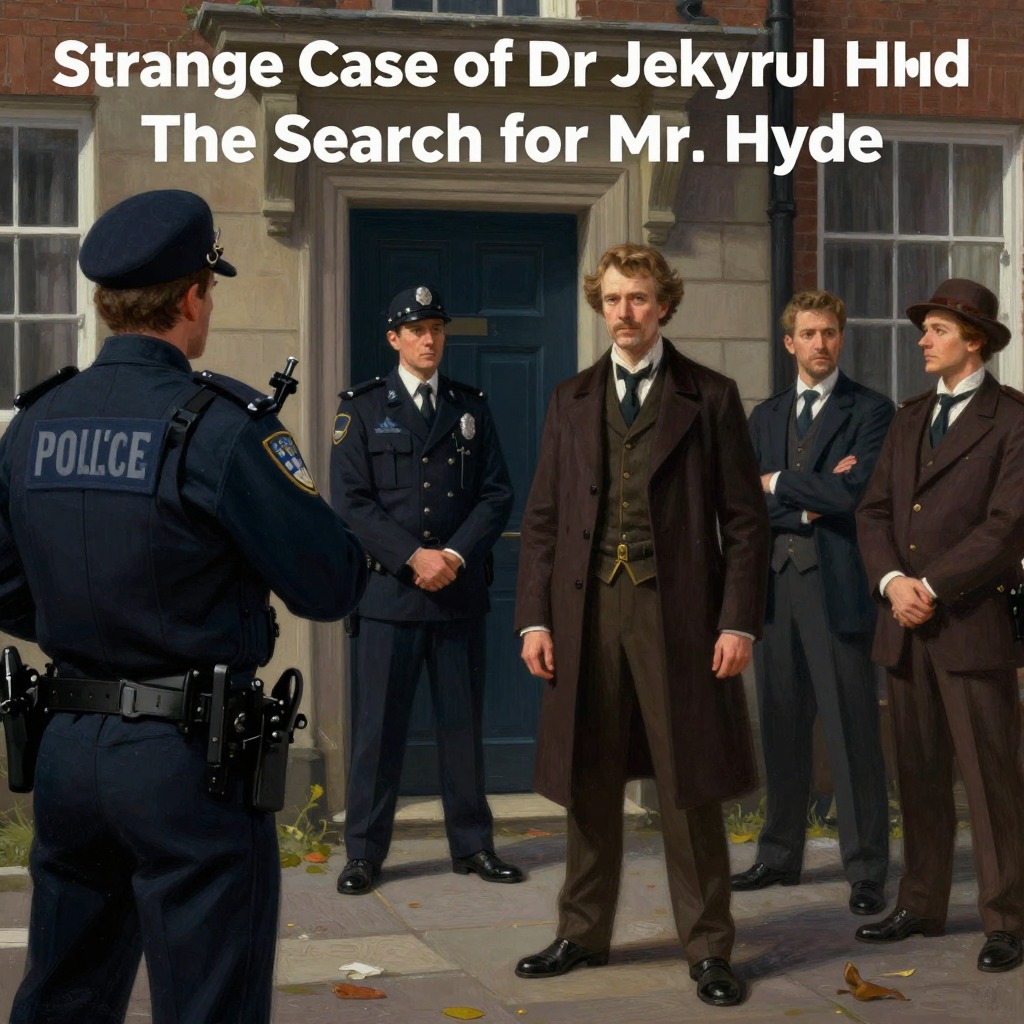
The maid came to herself at two o'clock and called for the police. The murderer was long gone, but his victim lay in the middle of the lane, incredibly mangled. The heavy cane, made of some rare, tough, and heavy wood, had broken in the middle under the stress of the insensate cruelty; one splintered half had rolled into the neighbouring gutter, the other had been carried away by the murderer. A purse and a gold watch were found upon the victim, but no cards or papers—except a sealed and stamped envelope bearing the name and address of Mr. Utterson. This envelope was brought to the lawyer the next morning before he was out of bed. He immediately recognised the victim as Sir Danvers Carew, a client and a friend. When the police showed him the broken stick, Utterson's doubts vanished: he recognised it as one he himself had presented many years before to Henry Jekyll. The maid described the murderer as particularly small and particularly wicked-looking. Utterson led the police to Hyde's house in Soho, where they found the rooms ransacked, a pile of grey ashes on the hearth (from which the inspector disinterred the butt end of a green cheque book), and the other half of the broken stick behind the door. A visit to the bank revealed several thousand pounds lying to the murderer's credit. The inspector declared himself delighted, confident he had the murderer in his hand.
Consequences and the Shift in the Narrative
The Carew murder case irrevocably alters the story's trajectory. It forces Mr. Utterson to confront Jekyll directly, who swears he will never set eyes on Hyde again and claims to have grounds for certainty that he cannot share. The murder also leads to the discovery of the letter from Hyde to Jekyll, and the subsequent revelation by Mr. Guest that the handwriting in the letter is remarkably similar to Jekyll's own, only differently sloped—a discovery that makes Utterson's blood run cold. The crime transforms Hyde from a merely repellent figure into a hunted fugitive, a known murderer whose face is now sought by all of London. It is this public, irreversible act of violence that finally shatters Jekyll's carefully constructed double life, driving him into seclusion and setting the stage for the final, tragic revelations of the narrative.